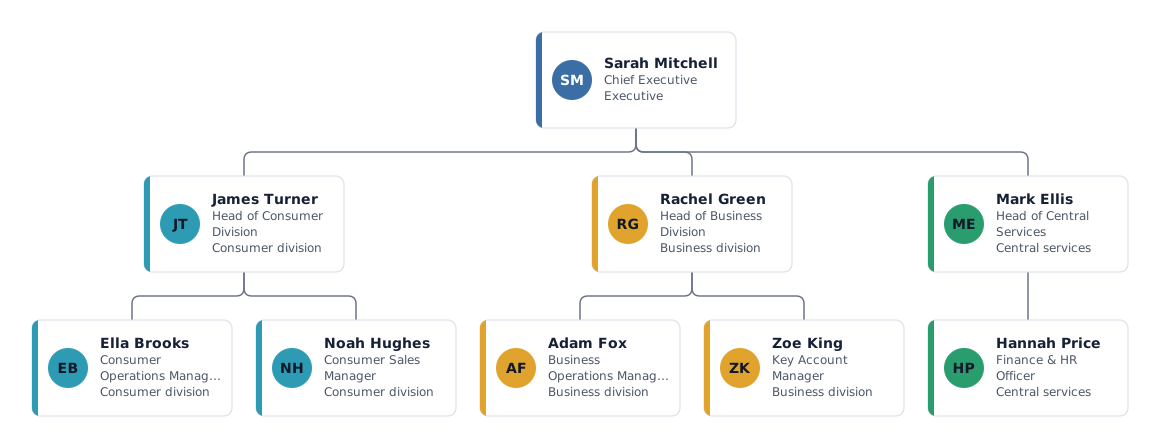
How a divisional structure works
Below the chief executive, the first split is by output, not by type of work. Each division head runs a business within the business: they have their own production or service delivery, their own sales and their own profit target. The head office sets strategy, allocates capital and measures results.
Divisions can be formed around products (consumer and professional equipment), regions (Europe, North America) or customer groups (retail, public sector). Alfred Chandler documented how DuPont and General Motors moved to this multidivisional, or M-form, structure in the 1920s as they grew into several markets.
When a divisional structure fits
It fits companies whose products or markets differ enough that one set of functions cannot serve them all well. Decisions move closer to the customer, and each division can be measured as its own profit centre.
It fits poorly in small companies, where duplicating sales or operations in every division is too expensive. It also creates friction when divisions compete for the same customers or refuse to share people and know-how.
An illustrative example
An appliance maker sells to households and to commercial kitchens. Households buy through retailers and care about design and price; commercial buyers need service contracts and custom installations. The company forms a consumer division and a business division, each with its own operations and sales. Finance and HR stay central to avoid duplication.
That is the chart above: two divisions side by side, plus central services reporting to the chief executive.
Advantages and disadvantages
| Advantages | Disadvantages |
|---|---|
| Clear accountability for results per division. | Duplicated functions and higher costs. |
| Decisions close to the customer and the market. | Divisions may compete instead of cooperating. |
| Divisions can be added, sold or closed with little disruption. | Specialist knowledge is spread thin across divisions. |
| Develops general managers who run a whole business. | Head office and divisions often argue over shared services. |
How to draw a divisional org chart in mivochart
- Add the chief executive, then one report per division and one for central services.
- Give each division its own department so it gets its own colour.
- Build each division's teams below its head; collapse a division to focus on another.
- Export a single division as its own PNG or PDF when you share it with that division only.
- Mark planned roles as open positions to show where a division is still hiring.
Related structures
Templates that use this structure
Prefer to start from a ready-made chart? These templates follow the same pattern and open in the editor with sample names.
Frequently asked questions
What are the types of divisional structure?
Product divisions, geographic divisions and customer or market divisions. Large companies sometimes combine them, for example product divisions with regional sales units inside each.
What is the difference between divisional and matrix structure?
In a divisional structure each person reports within one division. In a matrix, people report to two managers at once, typically a functional head and a product or regional manager.
Is a divisional structure the same as a holding company?
No. In a holding, the subsidiaries are separate legal entities. Divisions are usually parts of one company, though a holding can be organized by division in the same way.
When should a company switch to divisions?
Common signals are several products with different customers, a chief executive overloaded with product decisions, and functions that cannot serve all markets well. It is rarely worth it for a small company.
How do I show shared services in a divisional chart?
Put central services beside the divisions, reporting to the chief executive. If a central expert also works for a division head, add that head as a dotted-line manager.
Sources and further reading
- Alfred D. Chandler, Strategy and Structure (1962): the multidivisional (M-form) enterprise at DuPont and General Motors.
- Oliver E. Williamson, Markets and Hierarchies (1975): the M-form hypothesis.
- Henry Mintzberg, The Structuring of Organizations (1979): the divisionalized form.
Standard management textbook concepts. The example chart and the people in it are illustrative and fictional.