How a functional structure works
Work is divided by expertise. All accountants are in finance, all marketers in marketing, all planners in operations. Each function has a head, and the heads report to the chief executive, who is the first person responsible for the whole product from start to finish.
Inside each function, the reporting lines are usually a simple line organization. Coordination between functions happens at the top or through agreed processes: marketing forecasts demand, operations plans production, finance sets budgets. In Mintzberg's terms this is a typical machine bureaucracy; in Chandler's work it is the unitary or U-form company.
When a functional structure fits, and when it does not
It fits companies with one main product or service in a fairly stable market. Grouping specialists brings efficiency, deep expertise and clear careers. Most start-ups move to a functional structure once they hire their first managers.
It struggles when the company sells several products to different markets. Every product decision then needs agreement between all functions, and only the chief executive sees the whole picture. That is the classic trigger for a divisional structure or a matrix.
An illustrative example
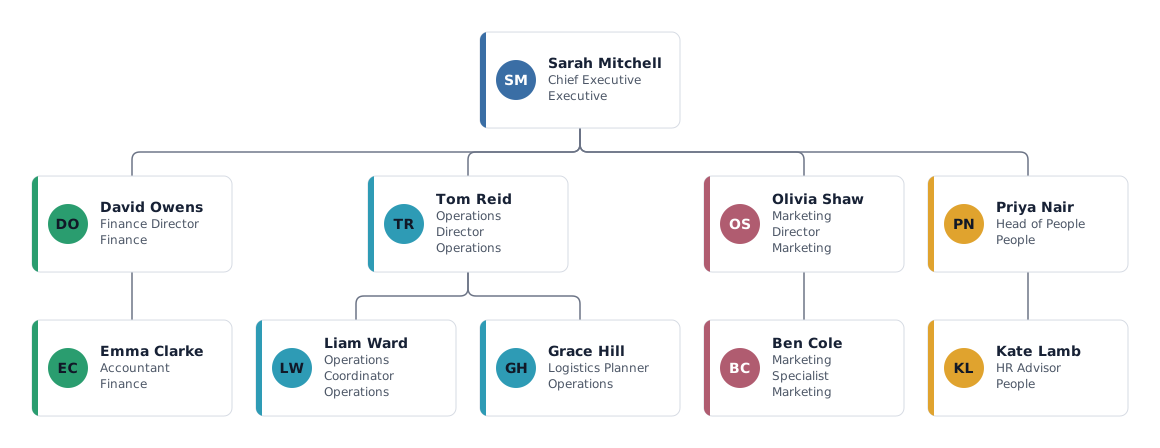
A company making one range of kitchen equipment has a finance director, an operations director, a marketing director and a head of people. A new model needs input from all four: marketing defines the features, operations plans the production line, finance approves the investment and people hires two technicians. The chief executive chairs the weekly meeting where these plans are aligned.
The example chart above shows this company: one row of functional heads under the chief executive, specialists below each head.
Advantages and disadvantages
| Advantages | Disadvantages |
|---|---|
| Deep expertise and efficient use of specialists. | Silo thinking: functions optimize their own goals. |
| Clear career paths within each profession. | Slow cross-functional decisions that escalate to the top. |
| No duplicated functions, so costs stay low. | Only the top sees the whole product or customer. |
| Easy to understand and to draw. | Scales badly to several products or markets. |
How to draw a functional org chart in mivochart
- Add the chief executive, then one report per function.
- Name each function as a department so every function gets its own colour.
- Add specialists under each head, or import your staff list from Excel or CSV with a department and a manager column.
- Turn on headcount on managers in the layout settings to show the size of each function.
- Use the list or grid layout if a function has many people at the same level.
Related structures
Templates that use this structure
Prefer to start from a ready-made chart? These templates follow the same pattern and open in the editor with sample names.
Frequently asked questions
What is a functional org chart?
It is an org chart in which the boxes under the top executive are functions such as finance, operations, marketing and HR, each with its own head and specialists. It shows who is responsible for which type of work.
What is the difference between functional and divisional structure?
A functional structure groups people by type of work across the whole company. A divisional structure first splits the company by product, region or customer, and each division then has its own functions.
Is a functional structure the same as Taylor's functional foremanship?
No. Taylor's functional foremanship gives each worker several specialist supervisors, which is a multi-line system. A functional structure keeps one manager per person and groups departments by function.
Which companies use a functional structure?
Typically companies with one main product or service: many small and mid-sized manufacturers, agencies and start-ups after their first round of hiring. Large firms often use it inside each division.
How do I show cross-functional work in a functional chart?
If a specialist regularly works for another function's manager, add that manager as a dotted-line manager. If this happens a lot, you are drawing a matrix.
Sources and further reading
- Alfred D. Chandler, Strategy and Structure (1962): the centralized, functionally departmentalized (U-form) company.
- Henry Mintzberg, The Structuring of Organizations (1979): grouping by function and the machine bureaucracy.
- Henri Fayol, General and Industrial Management (1916): the division of work.
Standard management textbook concepts. The example chart and the people in it are illustrative and fictional.