How line and staff work together
The line is the chain of command: managing director, heads of department, teams. Each person still has exactly one manager. Staff positions are attached to a line manager, usually at the top, and report to that manager, but nobody in the line reports to them. They prepare decisions; the line makes and enforces them.
The idea comes from the military general staff, where officers plan and advise the commander without commanding troops themselves. In companies, typical staff roles are legal, controlling, quality management, data protection, corporate strategy and executive assistance. On an org chart they appear beside the manager rather than in the row below.
When a line and staff structure fits
It fits a company that has outgrown the pure line: the managing director needs specialist input on contracts, quality or numbers, but a full extra department would be too much. Adding staff positions keeps the familiar chain of command and avoids the conflicting orders of a multi-line system.
It fits less well when staff roles quietly start giving instructions. If the quality manager regularly tells production what to do, the company has a functional authority line that the chart does not show. Either document it as a dotted line or give the role formal authority.
An illustrative example
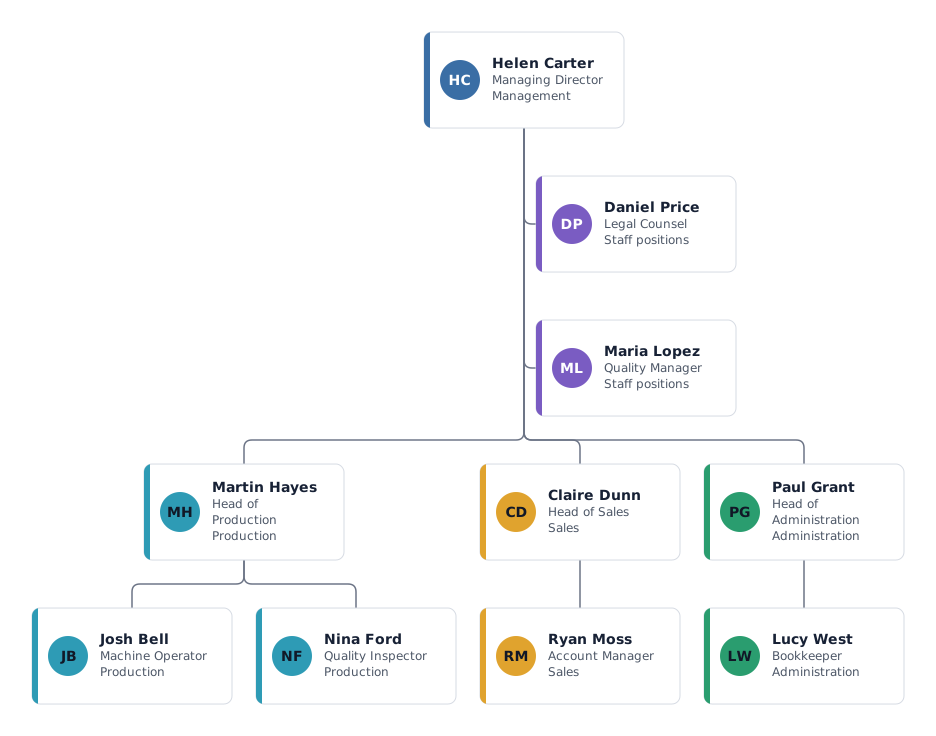
A manufacturer with three departments hires in-house legal counsel and a quality manager. Both report to the managing director. The quality manager audits production and proposes corrective actions; the head of production decides how and when to implement them. Legal counsel reviews contracts for sales, but the head of sales decides whether to sign.
The chart above shows exactly this: two staff positions beside the managing director, and the three line departments below.
Advantages and disadvantages
| Advantages | Disadvantages |
|---|---|
| Specialist expertise without breaking unity of command. | Staff may gain informal power without formal responsibility. |
| Relieves top management of analysis and preparation work. | Conflicts between staff advice and line decisions are common. |
| Better-prepared decisions, especially on legal and quality topics. | Staff roles add cost without producing anything directly. |
| Easy to add to an existing line organization. | Decisions can still be slow if the line ignores the advice. |
How to draw staff positions in mivochart
- Create the line structure first: top manager, heads of department, teams.
- Add the staff role as a report of the manager it supports.
- Open that person's details and switch on Assistant. The card moves beside the manager instead of into the team below.
- Give staff roles their own department, for example Staff functions, so they get a distinct colour.
- If a staff role does have functional authority over someone, add it to that person as a dotted-line manager.
Related structures
Templates that use this structure
Prefer to start from a ready-made chart? These templates follow the same pattern and open in the editor with sample names.
Frequently asked questions
What is the difference between line and staff?
Line positions have authority to give instructions and are responsible for results. Staff positions advise and prepare decisions for a line manager but cannot give orders to the line.
What are examples of staff positions?
Legal counsel, controlling, quality management, data protection officer, corporate strategy, communications and executive assistants are typical. Whether a role is staff depends on its authority, not on its title.
Where do staff positions go on an org chart?
Beside the manager they support, connected to that manager, and not in the row of direct reports below. That placement shows they belong to the manager but sit outside the chain of command.
Can a staff position lead its own team?
Yes. A legal department can have several lawyers who report to the head of legal. The department as a whole is still staff if it advises the line rather than directing it.
Is an executive assistant a staff position?
Usually, yes. An assistant supports one manager and has no authority over the line, which is why many org charts place the assistant beside the manager.
Sources and further reading
- Henri Fayol, General and Industrial Management (1916): the staff as support for the manager.
- The Prussian general staff of the 19th century, the usual historical model for staff roles.
- Harold Koontz and Cyril O'Donnell, Principles of Management (first edition 1955): line and staff authority.
Standard management textbook concepts. The example chart and the people in it are illustrative and fictional.