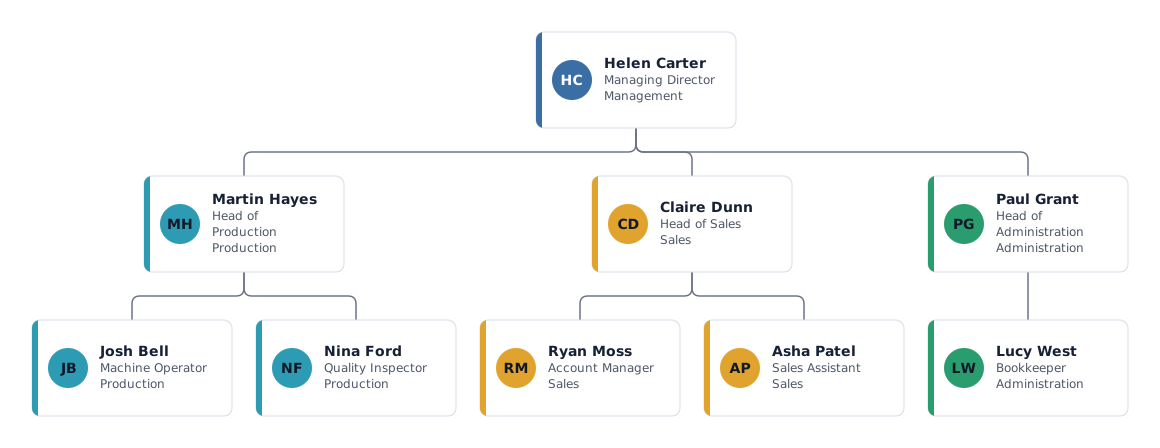
How a line organization works
The defining rule is unity of command: one person, one boss. Henri Fayol described it in 1916 alongside the scalar chain, the unbroken line of authority from the top manager down to the newest employee. In a line organization, that chain is the only official channel for instructions, approvals and escalation.
If a machine operator needs a decision from sales, the formal route goes up to the head of production, across to the managing director if needed, and down to the head of sales. In practice people talk to each other directly, but decisions and instructions still follow the line. That keeps responsibility clear and makes the chart easy to read: every box has exactly one line going up.
When a line organization fits, and when it does not
The line structure works best where the work is predictable and the organization is small enough that the top can still oversee it. Many owner-managed businesses, public offices and craft firms run this way without ever calling it a structure.
It fits poorly when work needs constant coordination across departments, when specialist knowledge is needed in many places at once, or when the chain gets so long that decisions take weeks. Those are the points where companies add staff roles, switch to divisions or introduce a matrix.
An illustrative example
Picture a manufacturer with around 40 employees. The managing director leads three heads: production, sales and administration. The production head plans shifts and quality checks; the sales head handles customers and quotes; the administration head runs bookkeeping and HR paperwork. When a customer wants a rush order, the head of sales agrees the date with the head of production, and if they disagree, the managing director decides.
Nothing about this is unusual, which is the point: a line organization is the default shape most small companies grow into. The example chart above shows a smaller version of this company.
Advantages and disadvantages
| Advantages | Disadvantages |
|---|---|
| Clear responsibility: everyone knows who their manager is and who decides. | Long official paths between departments slow decisions. |
| Simple to understand, draw and explain to new employees. | Managers at the top become a bottleneck as the company grows. |
| Discipline and accountability are easy to enforce. | Specialist knowledge has no formal place outside the line. |
| Low coordination overhead in small organizations. | Departments tend to optimize for themselves instead of the whole. |
How to draw a line organization in mivochart
- Open the example above, or start an empty chart and add the top manager first.
- Select a person and use Add report to create each direct report; drag a card onto another person to change its manager.
- Give each person a department so teams share a colour.
- Set part-time working time (FTE) or mark a box as an open position in the person's details.
- Export the finished chart as PNG, SVG or PDF, or import your staff list from Excel instead of typing it.
Related structures
Templates that use this structure
Prefer to start from a ready-made chart? These templates follow the same pattern and open in the editor with sample names.
Frequently asked questions
Is a line organization the same as a hierarchical structure?
Mostly, yes. Line organization stresses the single chain of command; hierarchical structure stresses the levels of management. A line organization is always hierarchical, though a hierarchy can also include staff roles or dotted lines.
What is unity of command?
Unity of command means each employee receives instructions from only one manager. Henri Fayol listed it among his principles of management. It prevents conflicting orders but makes cross-department work slower.
How many people can one manager lead in a line organization?
There is no fixed number. Five to ten direct reports is common for managers who also do hands-on work; managers of routine, similar tasks can lead more. If a manager has many more, consider adding a level or flattening deliberately.
Why do companies move away from a pure line organization?
Usually because they grow. The top becomes overloaded, departments need each other more often, and specialist expertise is needed across the line. Adding staff roles is the smallest change; divisions or a matrix are larger ones.
How do I show part-time employees in a line organization chart?
Keep them in their position in the line and record their working time. In mivochart you set the working time (FTE) per person, and team totals add up automatically.
Sources and further reading
- Henri Fayol, General and Industrial Management (Administration industrielle et générale, 1916): unity of command and the scalar chain.
- Max Weber, Economy and Society (1922): the hierarchy of offices in a bureaucracy.
- Henry Mintzberg, The Structuring of Organizations (1979): the simple structure and the machine bureaucracy.
Standard management textbook concepts. The example chart and the people in it are illustrative and fictional.