How a flat structure works
The key variable is span of control: how many people one manager leads. In a tall structure, each manager leads a few people and there are many levels. In a flat structure, one leader has many direct reports and there are one or two levels. Responsibility is pushed to individuals and small groups who coordinate directly with each other.
Flat does not mean structureless. Someone still hires, sets priorities and resolves conflicts. Decision rights simply sit lower, and coordination relies on shared goals, transparent information and direct conversation instead of approval chains.
When a flat structure fits
It fits small organizations, early-stage start-ups and teams of experienced specialists who need little supervision. Communication is fast and everyone sees the whole business.
It fits poorly once headcount grows. A leader with 15 direct reports cannot give each of them real attention, and informal hierarchies form anyway. Most companies add a first layer of team leads somewhere between 15 and 30 people, and the chart should show that honestly when it happens.
An illustrative example
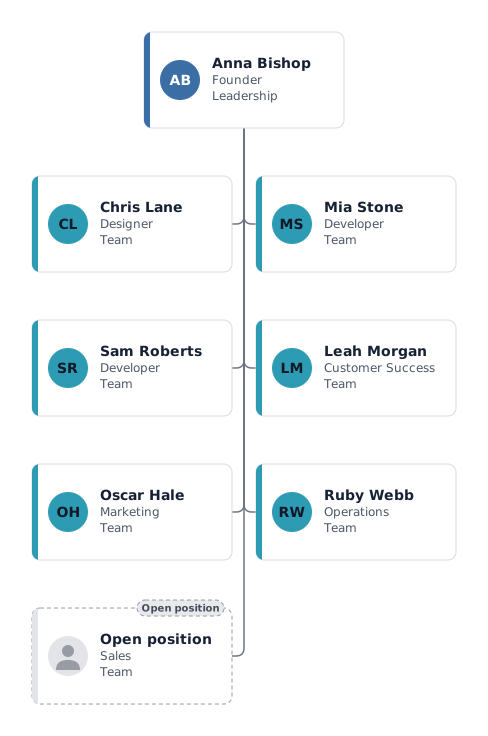
A product studio with eight people: a founder and seven specialists in design, development, customer success, marketing, operations and sales. Everyone reports to the founder, who holds a weekly planning meeting and one-to-ones every two weeks. The sales role is open, and the marketer works three days a week.
The example chart shows exactly this team. Open it to see how a flat chart reads, then try the grid layout to keep it compact.
Advantages and disadvantages
| Advantages | Disadvantages |
|---|---|
| Fast decisions and short communication paths. | The leader becomes overloaded as the team grows. |
| More autonomy and responsibility for each person. | Informal hierarchies form without being visible. |
| Lower management costs. | Fewer promotion steps and unclear career paths. |
| Everyone sees how their work affects the whole. | Hard to scale beyond a few dozen people. |
How to draw a flat org chart in mivochart
- Add the leader, then use Add report for each person.
- Switch the team to the grid layout so a wide row of direct reports stays readable.
- Mark planned roles as open positions so the chart doubles as a hiring plan.
- Turn on headcount on managers to see the span of control at a glance.
- When you add team leads later, drag people onto their new lead to change their manager.
Related structures
Templates that use this structure
Prefer to start from a ready-made chart? These templates follow the same pattern and open in the editor with sample names.
Frequently asked questions
What is a flat organizational structure?
A structure with few or no middle management levels, where most employees report directly to one leader or a small leadership team and make many decisions themselves.
What is the difference between flat and hierarchical structure?
A hierarchical structure has several management levels with narrow spans of control. A flat structure has few levels and wide spans of control, so decisions are made closer to the work.
How many direct reports are too many?
It depends on the work. Experienced specialists doing independent work need less supervision than new staff in routine jobs. When one-to-ones and feedback start to slip, the span is too wide.
Is a flat structure the same as holacracy?
No. Holacracy is a specific system with self-organizing circles and written rules. A flat structure simply means few management levels and can be run in many ways.
Sources and further reading
- Vytautas Graicunas, Relationship in Organization (1933): span of control and the number of relationships.
- Henry Mintzberg, The Structuring of Organizations (1979): the simple structure and the adhocracy.
- Tom Burns and G. M. Stalker, The Management of Innovation (1961): mechanistic versus organic organizations.
Standard management textbook concepts. The example chart and the people in it are illustrative and fictional.