Glossary
Chain of command: definition and examples
The chain of command is the line of authority in an organization: who gives instructions to whom, from the top executive down to each employee, and the path that decisions, approvals and escalations follow. In an org chart it is the sequence of solid reporting lines that connects any person to the top of the organization.
Why does the chain of command matter?
A clear chain of command answers three everyday questions: who may assign me work, whom do I ask for a decision, and where do I go when something goes wrong. When the answers are clear, decisions are made at the right level and nobody receives contradictory instructions.
The concept goes back to the principle of unity of command, formulated by Henri Fayol: each employee should receive instructions from one superior only. Modern organizations relax that principle with dotted lines and matrix structures, but the formal chain still decides on appraisal, pay and discipline.
How do you read the chain of command in an org chart?
Pick any box and follow the solid line upwards. Each box you pass is one link in that person’s chain of command, up to the head of the organization. The number of links is the number of management levels between that person and the top.
Staff positions are not part of the chain: they sit beside a manager and advise, but nobody reports to them on a solid line. Dotted lines are not part of it either; they show secondary relationships.
What is the difference between a long and a short chain of command?
A long chain, with many levels, gives close supervision but slows decisions down: a request may pass four or five people before someone can approve it, and information gets filtered on the way. A short chain, typical of flat structures, speeds things up but gives each manager more people to lead.
The length of the chain is directly linked to span of control. For the same number of employees, wider spans mean a shorter chain.
Is it wrong to go around the chain of command?
Bypassing your manager on decisions that belong to them usually causes friction. Many organizations nevertheless create deliberate exceptions: skip-level meetings with the manager’s manager, open-door policies, or a works council or whistleblowing channel. These are communication channels, not a second chain of command; the decision path stays the same.
Which chart mistakes hide the real chain of command?
Drawing people at the same height when they are at different levels hides the chain: a team lead drawn next to the heads of department looks like their peer. Leaving out a level to save space does the same. And a chart that shows a project lead above project members, when the members report to their department heads, mixes the project and the line organization. Use dotted lines for the project.
Example: following the chain from bottom to top
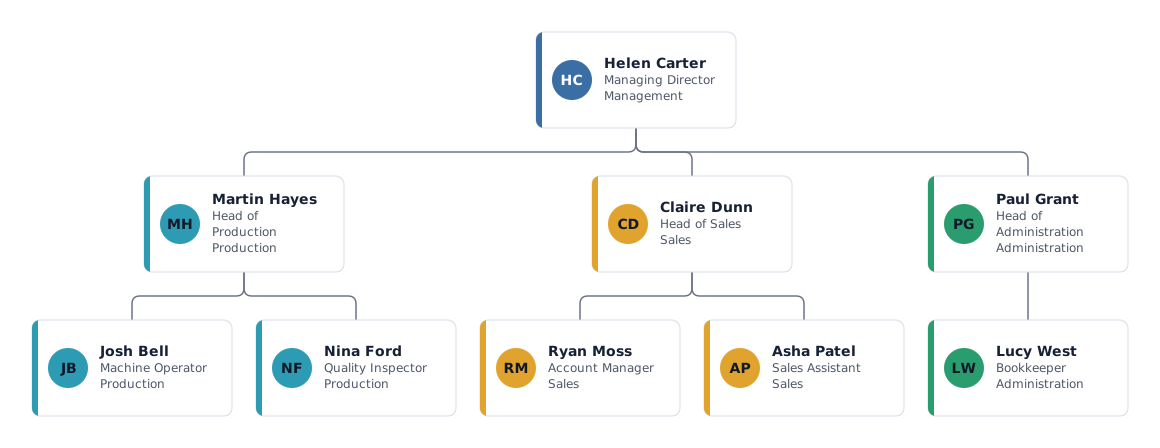
In this hierarchical chart, the machine operator Josh Bell reports to Martin Hayes, head of production, who reports to the managing director Helen Carter. That is Josh’s chain of command: two links to the top. The account manager Ryan Moss has an equally long chain through Claire Dunn, head of sales.
The term in other languages
| English | German | French |
|---|---|---|
| Chain of command | Dienstweg (Instanzenweg) | Chaîne hiérarchique |
| Line organization (single-line system) | Einliniensystem | Structure hiérarchique (linéaire) |
| Hierarchy level (management layer) | Hierarchieebene (Führungsebene) | Niveau hiérarchique |
Frequently asked questions
What is an example of a chain of command?
In a shop: a sales assistant reports to the store manager, who reports to the regional manager, who reports to the head of retail. Instructions go down that line and escalations go up it.
What does unity of command mean?
Unity of command is the principle that each employee takes instructions from one superior only. It keeps responsibilities clear and is the basis of the classic line organization.
Does a matrix organization break the chain of command?
It adds a second line for the work, usually drawn as a dotted line, but each person still has one line manager. Conflicts between the two lines need agreed rules.
What is chain of command called in German and French?
German usually says Dienstweg or Instanzenweg; French says chaîne hiérarchique or voie hiérarchique.
Related terms
- Line organization (single-line system)
- Hierarchy level (management layer)
- Span of control
- Skip-level manager
- Direct report
- Staff position