Glossary
Direct report: meaning and examples
A direct report is an employee who reports to a manager directly, with no other manager in between. The manager is responsible for that person’s objectives, appraisal and approvals. Everyone further down the same branch of the org chart is an indirect report. The number of direct reports is the manager’s span of control.
What is the difference between direct and indirect reports?
Direct reports are one level below the manager on a solid line. Indirect reports are the direct reports of those people, and so on down the branch. A head of department with three team leads has three direct reports, but every employee in the three teams is an indirect report.
The difference matters in practice: one-to-ones, appraisals and approvals usually happen with direct reports only, while indirect reports are reached through their own managers or in skip-level meetings.
How are direct reports shown in an org chart?
Each direct report is connected to the manager by a solid line, and they sit together in the row or column below. Staff positions such as an assistant are often placed beside the manager rather than among the direct reports. Dotted-line reports are drawn with a dashed line and are not counted as direct reports.
For managers with many direct reports, a list or grid layout keeps the team compact instead of producing one very wide row. In mivochart you can switch each team between tree, list and grid.
How many direct reports are normal?
It depends on the work. Teams doing similar, well-defined tasks can work with ten or more direct reports per manager; senior managers whose direct reports lead complex areas often have far fewer. When a manager has only one direct report, ask whether that level is needed at all.
What mistakes are common?
Charts often hide direct reports by grouping them into a single “team” box, which makes the span of control invisible. Another mistake is drawing a dotted-line relationship as a solid line, which turns a project contributor into a direct report on paper. Vacancies should stay on the chart as open positions: they are future direct reports and part of the manager’s span.
Example: three direct reports
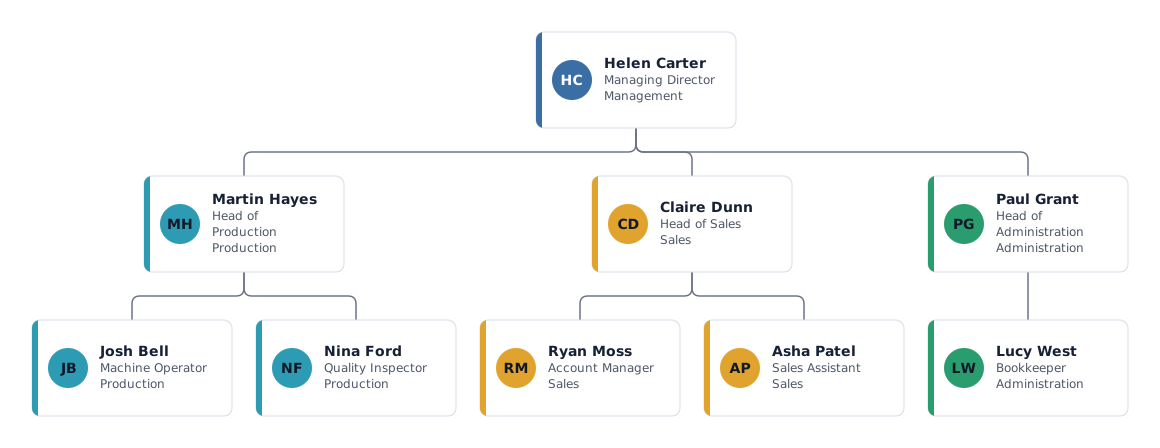
In this chart, the managing director Helen Carter has three direct reports: the heads of production, sales and administration. The five employees in their teams are her indirect reports. Claire Dunn, head of sales, has two direct reports of her own.
The term in other languages
| English | German | French |
|---|---|---|
| Direct report | Direkt unterstellte Mitarbeitende ≈ | Collaborateur direct (N-1) |
| Line manager | Disziplinarische(r) Vorgesetzte(r) | Supérieur hiérarchique (N+1) |
| Span of control | Leitungsspanne (Kontrollspanne) | Étendue du contrôle (ou de supervision) |
Frequently asked questions
What is a direct report in simple terms?
Someone whose manager you are, with nobody in between. If you write their appraisal and approve their leave, they are almost certainly your direct report.
Is a dotted-line report a direct report?
Not usually. A dotted-line report works with you on some tasks, but their line manager is someone else. Most organizations count only solid-line reports as direct reports.
What is a direct report called in German and French?
German has no single word; people say direkt unterstellte Mitarbeitende or, in many companies, simply Direct Reports. French uses collaborateur direct, often written N-1 from the manager’s point of view.