Glossary
Span of control: what it means and how wide it should be
Span of control is the number of employees who report directly to one manager. A manager with seven direct reports has a span of control of seven. Wide spans lead to flatter organizations with fewer management levels; narrow spans allow closer supervision but add levels. In German it is the Leitungsspanne, in French the étendue du contrôle.
What is the difference between a wide and a narrow span of control?
With a wide span, one manager leads many people. The organization needs fewer managers and fewer levels, decisions travel a shorter way, and employees get more room to work independently. The price is less time per person for coaching and review.
With a narrow span, each manager leads only a few people. There is more time for guidance and quality control, but the organization grows taller: more levels, longer chains of command and more management cost for the same number of employees.
How many direct reports should a manager have?
There is no universal number. Classic management writers such as Lyndall Urwick argued for small spans of around five or six at senior levels, where subordinates’ work is closely interlinked. Teams doing similar, well-defined work can be led with far wider spans.
In 1933 V. A. Graicunas pointed out why spans cannot grow freely: each new direct report adds not only one relationship but many group relationships. His formula n × (2^(n−1) + n − 1) gives 100 possible relationships for five direct reports and 222 for six. The exact numbers matter less than the point: complexity grows much faster than headcount.
- Similarity of the work: the more alike the jobs, the wider the span can be.
- Experience of the team: experienced, independent people need less supervision.
- The manager’s own workload: a manager who also does specialist work needs a narrower span.
- Location: spread-out or remote teams usually need more coordination time.
How does span of control show in an org chart?
You can read it straight from the chart: count the boxes connected directly below a manager. Staff positions and assistants beside the manager are usually counted separately, because they advise rather than form part of the team. Dotted-line reports are not counted either; the span refers to solid-line reports.
A chart with very wide rows and few levels points to wide spans. A tall, narrow chart with many single boxes stacked above each other points to narrow spans, and often to levels that could be removed.
What mistakes are common when judging span of control?
Counting the whole department instead of direct reports is the most frequent one: a head of department with three team leads has a span of three, even if fifty people work below them. Another is creating a team-lead level only to keep spans small, which adds a management layer without adding leadership. A third is ignoring vacancies: an open position still belongs to the manager’s span once it is filled.
Example: a wide and a narrow span compared
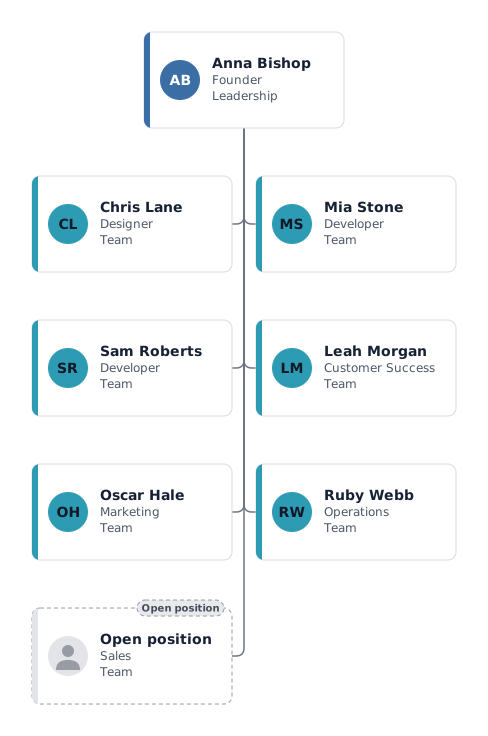
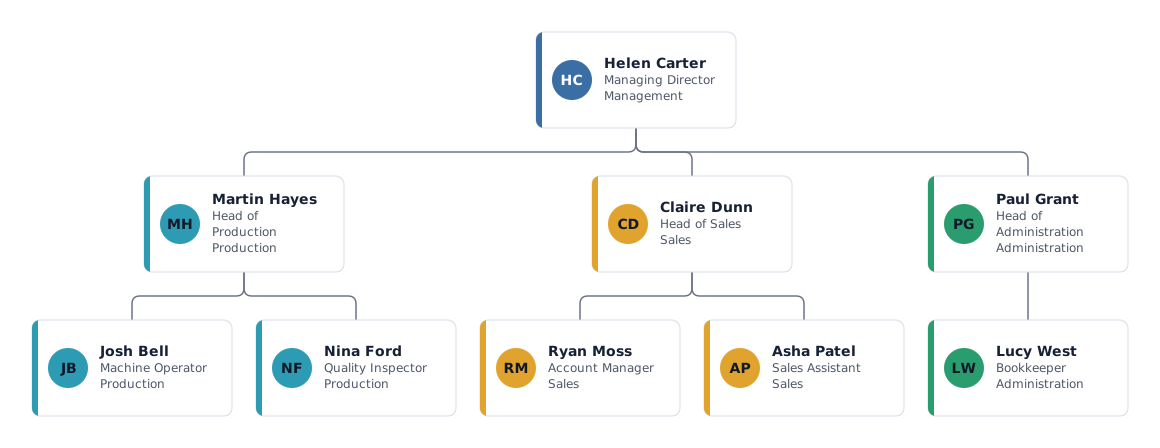
In the first chart the founder leads seven people directly, one of them an open position: a span of seven and only two levels. In the second, the managing director leads three heads of department, who each lead one or two people: spans of one to three, but three levels. Both charts have about the same number of people.
The term in other languages
| English | German | French |
|---|---|---|
| Span of control | Leitungsspanne (Kontrollspanne) | Étendue du contrôle (ou de supervision) |
| Direct report | Direkt unterstellte Mitarbeitende ≈ | Collaborateur direct (N-1) |
| Hierarchy level (management layer) | Hierarchieebene (Führungsebene) | Niveau hiérarchique |
Frequently asked questions
What is span of control called in German and French?
German uses Leitungsspanne, sometimes Kontrollspanne or Führungsspanne. French uses étendue du contrôle or étendue de supervision.
Do assistants count towards a manager’s span of control?
Usually not. Assistants and other staff positions support the manager rather than form part of the team, so they are counted separately. Say which way you count when you compare spans across departments.
Is a wider span of control always better?
No. A wider span saves management levels and speeds up decisions, but only works when the team is experienced and the work is similar. Too wide a span leaves people without guidance.
How is span of control related to the number of hierarchy levels?
For the same number of employees, wider spans mean fewer levels and narrower spans mean more. That is why flattening an organization always means widening spans somewhere.
Related terms
- Direct report
- Hierarchy level (management layer)
- Flat structure
- Line organization (single-line system)
- Chain of command