Glossary
What is an org chart?
An org chart, short for organizational chart, is a diagram that shows how an organization is structured: every position appears as a box, and lines connect each person to the manager they report to. It answers who does what, who reports to whom and how teams are grouped, at a glance.
What is an org chart used for?
Most org charts are made for people who need to find their way around an organization: new employees, colleagues in other departments, customers or a board. A good chart replaces dozens of questions about who is responsible for what.
Managers also use the chart as a working tool. When it is drawn, gaps and imbalances become visible: a manager with twelve direct reports, a team without a lead, two departments doing the same job, or a vacancy nobody has budgeted for.
- Onboarding: show new starters their team, their manager and the people they will work with.
- Planning: model a reorganization or a new team before it is announced.
- Communication: put an up-to-date chart on the intranet, in a handbook or in a funding application.
What does an org chart show, and what does it leave out?
An org chart shows the formal structure: positions, names, job titles, departments and reporting lines. Many charts also mark open positions, part-time working time as FTE, staff positions beside a manager and dotted lines to a second manager.
It does not show how work actually flows, who influences decisions informally, or how processes run from one team to the next. For those questions you need a process map or a RACI matrix. Keep the chart focused on structure: once it tries to show everything, nobody can read it.
What types of org chart are there?
The drawing follows the structure. A hierarchical (line) org chart has one manager per person. A line-and-staff chart adds advisory staff positions. A functional chart groups people by function, a divisional chart by product or region, and a matrix chart shows people with two managers. Flat structures have only one management level.
For large organizations, one chart per department is often more readable than a single poster. The overview chart then stops at heads of department.
How do you draw an org chart that people can read?
Start at the top with the head of the organization and work down level by level. Give every box the same information, usually name and job title, and keep the same order of teams on every level.
- Use one solid line per person to their line manager; add dotted lines only where a second reporting line really exists.
- Place staff positions such as an assistant or legal counsel beside the manager, not in the team below.
- Colour by department, not by person, and explain the colours once.
- Show vacancies as open positions instead of leaving gaps.
- Date the chart. An org chart without a date is assumed to be current, even when it is not.
Which mistakes make an org chart misleading?
The most common one is an outdated chart: people who left are still on it and new teams are missing. The second is mixing levels, for example drawing an assistant at the same level as heads of department, which suggests authority they do not have. The third is cramming a whole company onto one page until the text is unreadable.
Example: a small company
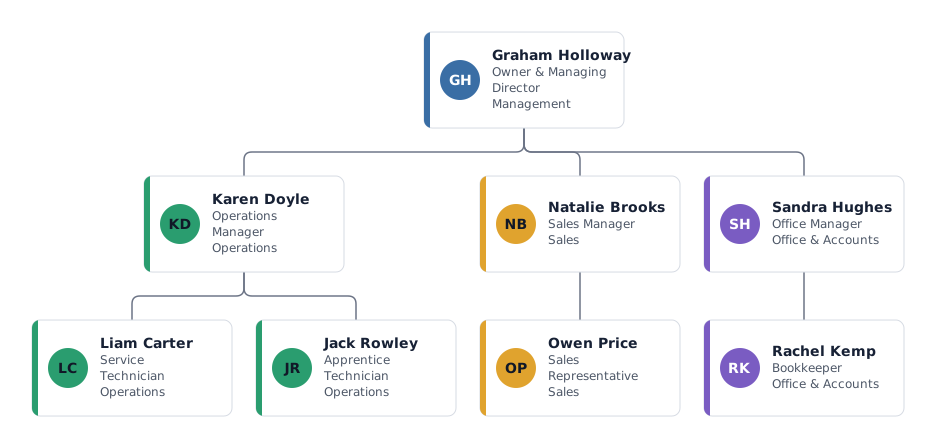
This small company has an owner at the top, three areas below and four employees in the teams. Reading from the top, you see the chain of command, every team’s lead and who each person reports to. Open it in the editor to replace the names with your own or to add people.
The term in other languages
| English | German | French |
|---|---|---|
| Org chart (organizational chart) | Organigramm | Organigramme |
| Organizational structure | Aufbauorganisation | Structure organisationnelle |
Frequently asked questions
Is an org chart the same as an organizational chart?
Yes. Org chart is the short form of organizational chart (organisational chart in British English). Both mean the diagram of positions and reporting lines.
What is an org chart called in German and French?
In German it is an Organigramm, in French an organigramme. Both words come from the same root and mean exactly the same diagram.
How often should an org chart be updated?
Whenever someone joins, leaves or changes manager. In practice many teams update it monthly from the HR staff list, because a chart that is a few months old is already wrong in places.
Can I make an org chart from an Excel list?
Yes. If your list has a column for each person’s manager, the chart can be built from it automatically. mivochart imports .xlsx and .csv files and recognises the usual column names in English, German and French.
Related terms
- Organizational structure
- Staff position
- Span of control
- Dotted-line reporting
- Chain of command
- Line organization (single-line system)