How a project organization works
Typical roles are a sponsor or steering committee that owns the business case, a project manager who plans and steers, a project office (PMO) that handles planning, reporting and risk logs, and workstream leads who run parts of the work with their team members. Many team members keep their line manager in the permanent organization.
Three classic forms exist. In a pure (projectized) organization, team members move fully into the project and report to the project manager. In a matrix project organization, they stay in their departments and work part of their time for the project. In a staff-based (influence) project organization, the project manager only coordinates and advises, while the line managers keep authority.
When each form fits
Large, critical, long projects justify a pure project organization with a full-time team. Medium projects that need specialists from several departments usually run as a matrix. Small, low-risk projects can be coordinated in a staff-based form without moving anyone.
Whatever the form, the project chart should show who decides on scope, budget and people. Unclear authority between project manager and line managers is the most common cause of friction.
An illustrative example
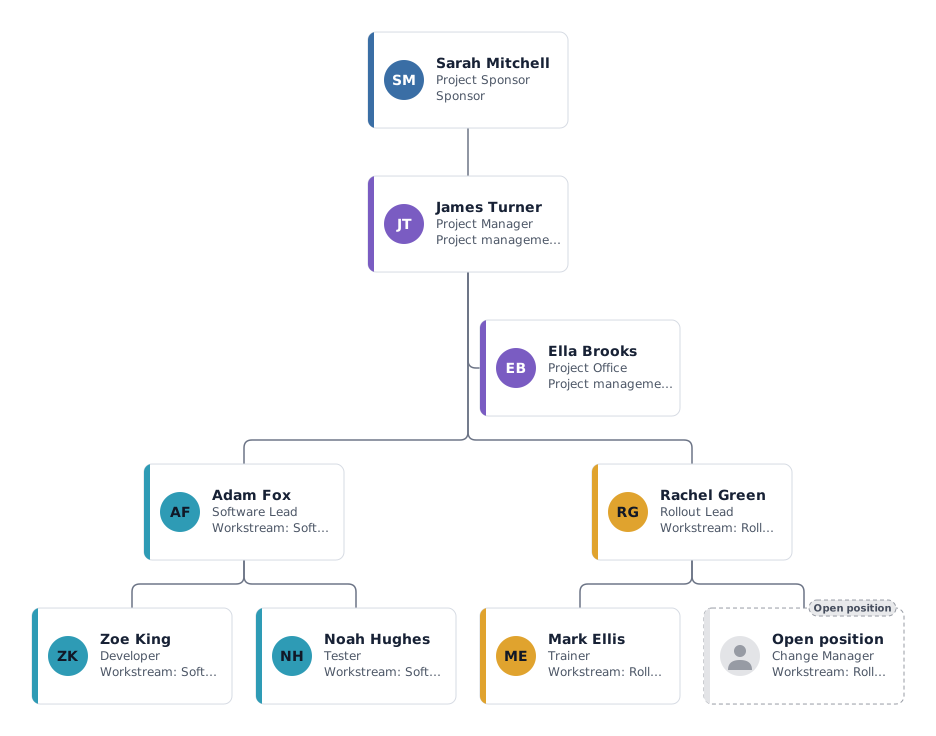
A company introduces a new booking system. The sales director is the sponsor and chairs the steering committee. A project manager leads two workstreams: software (a lead, a developer and a part-time tester) and rollout (a lead, a trainer and a change manager still to be hired). A project office supports the project manager with plans and status reports.
The example chart shows exactly this, with the open change-manager role marked so everyone can see the gap.
Advantages and disadvantages
| Advantages | Disadvantages |
|---|---|
| Clear ownership and focus on one goal. | Conflicts with line managers over people's time. |
| Brings together people from different departments. | Team members may lose their place in the line after the project. |
| Flexible: set up and dissolved as needed. | Duplicated effort in pure project organizations. |
| Makes resources and gaps of the project visible. | Weak authority for the project manager in staff-based forms. |
How to draw a project org chart in mivochart
- Add the sponsor at the top and the project manager as their report.
- Add the project office as a report of the project manager and switch on Assistant to place it beside them.
- Create a report per workstream lead and add their team members below.
- Mark roles that are not filled yet as open positions and set part-time working time (FTE).
- If team members also report to a line manager, add that manager as a dotted-line manager, or keep the chart to project roles only.
Related structures
Templates that use this structure
Prefer to start from a ready-made chart? These templates follow the same pattern and open in the editor with sample names.
Frequently asked questions
What are the three types of project organization?
The pure (projectized) organization, the matrix project organization and the staff-based or influence project organization. They differ in how much authority the project manager has over the team.
What is the role of a steering committee?
It approves the project's scope, budget and major changes and resolves conflicts the project manager cannot. It usually includes the sponsor and the heads of the departments involved.
What does a project office (PMO) do?
It supports the project manager with planning, reporting, risk and issue logs and documentation. In larger companies a permanent PMO supports several projects at once.
Should a project org chart show line managers?
Only if it helps. For clarity, many teams show project roles only. If you want to show that someone remains in their department, add their line manager as a dotted-line manager.
How do I show part-time project members?
Set their working time (FTE) on the project chart, for example 0.5 for half their time. Totals per workstream show how much capacity the project really has.
Sources and further reading
- Project Management Institute, PMBOK Guide: functional, matrix and projectized organizations.
- Harold Kerzner, Project Management: A Systems Approach to Planning, Scheduling, and Controlling.
- Jay R. Galbraith, Designing Complex Organizations (1973): project and matrix forms.
Standard management textbook concepts. The example chart and the people in it are illustrative and fictional.